Showing posts with label restaurant review. Show all posts

Sunday, December 21, 2014

Zak and Tonics Asian Pop-Up

Zak and Tonic are as ubiquitous in Durban outdoor dining circles as bunny chows or braaivleis. You’ve eaten their silky and elegant crepes at The Morning Trade at 8 Morrison. You’ve devoured their Super Steak Rolls at the I Heart Market, or their fragrant pulled pork buns at the Market in the Square. You’ve seen them at the Wonder Market, you’ve spotted them on rooftop pop ups, and chances are you’ve even been hosted by them at one of Durban’s always popular Secret Eats evenings.
This was a unique opportunity though to see what they could really do when given free reign over a menu and a kitchen, for two nights only with forty people dropping in for an Asian inspired feast.
The venue was The Foundry at 43 Station Drive – a renovated former clothing factory, and now a creative space that hosts workshops, studios and collaborative offices. For the night though, it had been transformed into a hidden Asian underworld. Two long trestle tables covered in cryptic Chinese newspaper and lined with chairs and benches were dotted with candles, while fairy lights illuminated the room and supported strings of airy origami cranes.
Zack and Tonic pop up restaurant DurbanWelcome drinks were strong and pink, and segued nicely into a cash bar, which was doing a roaring trade in wine, champagne and craft beers. Zak was everywhere, plying the guests with generous tray-fulls of pea and green tea croquettes with kewpie mayo, while waiters handed out painstakingly handmade sago chips with a peanuty Thai dip. The volume levels climbed as the room filled up, and soon we were jostling for places at the tables as a beautiful starter of Tonic’s take on kim chi and prawns was served on folded banana leaves.
Zack and Tonic pop up restaurant DurbanFor me, though, the magic was really revealed with the dim sum courses. Bamboo baskets of steamed buns (char siu bao) were unveiled, their plump soft roundness just asking to be broken open and enjoyed. Crispy chicken wontons were held aloft on chopstick points, and dunked in sweet dipping sauce before being eaten, and platefuls of dumplings circled the table, at first handed over grudgingly, and then more freely, as the extent of the bounty was revealed, with plate after plate distributed among the diners.
To be honest, the next course probably wasn’t strictly necessary – as we were already as full as the well-stuffed dim sum we had just demolished. The description of the beef short ribs had us ready for more, though, with cooking times of six to eight hours bandied about, and obscene details revealed about the meat falling off the bones. Let’s just say that you know a rib is tender when you can eat it with your chopsticks.
Zack and Tonic pop up restaurant DurbanFinally, we were presented with coconut flavoured ‘sunscreen’ ice cream topped with some kind of ginger snap, and an old enamel bowl filled with white rabbit candies – what is it with those sweets that makes the rice paper wrapping taste so good as it melts on your tongue?
Zack and Tonic pop up restaurant DurbanTired, sated, and buzzing with beer and good conversation, we trickled out to the waiting cabs, Uber rides and Good Fellas. There were hardly enough hours left for a good night’s sleep before it would be time for my Saturday morning park run ritual. At least I knew I would be able to pop by Moses Mabhida for a Zak and Tonic steak roll if I needed it.
Want to know what Zak and Tonic are up to next? Join their mailing list at hello@zakandtonic.co.za, find them on Facebook, or follow them on Twitter @ZakandTonic.

Sunday, July 13, 2014

Bellevue Café

Bellevue Café in Kloof is something of a local favourite, with its beautifully designed spaces, indoor/outdoor appeal and double volume interior. Popular with families, it’s a great place to sit back and relax while enjoying the dappled shade under the trees on the patio. After a meal, there is also a shop next door which is full of interesting gifts, and a gallery above the restaurant, both of which add to the arty, hipster vibe of the place.


The café is open all day, but we were there on a mission for brunch. The breakfast menu is available until 11.30, and features a pitcher of orange juice paired with a bottle of champagne, so you know that they take mornings seriously.

There is a fairly extensive menu that takes in all of the usual suspects, as well as offering some more interesting choices. I opted for the Bellevue Billionaire’s Club (with that name, how could you not?) which involves truffled scrambled eggs, bacon, tomato chutney and parmesan on rye. The rest of the brunching party each went their separate ways; one choosing an exotic poached eggs, avocado hummus, bacon and dukka on rye creation; another going with classic French toast and bacon, and the last with the spicy chicken livers on toast, topped with a fried egg.

The Billionaires Club was pretty good, with creamy scrambled eggs, albeit without any detectable hint of truffle, making it maybe more of a Millionaires Club. The poached egg creation had eggs that were perfectly done, soft and golden – although the hummus seemed to have disappeared, and the dukka, which was such an interesting sounding addition, was simply a sprinkled garnish, rather than an integral part of the dish.


The French toast and bacon proved something of a winner, with a generous heap of moist, fluffy French toast, piles of bacon and plenty of maple syrup. The chicken livers were also well received, being spicy as advertised and served in a rich sauce which soaked nicely into the toast.


Coffee was good – try the sweet and strong Turkish coffee, and orange juice arrives in enormous glasses (seriously, you could share if you were so inclined). We stayed on, lingering in the winter sun, and eventually left before we were tempted to move on to lunch…


Thursday, May 22, 2014

Bar Ba Coa, Umhlanga

The primal appeal of a flawlessly cooked steak has been expounded upon at length by writers and gourmands alike, and I will not attempt to outdo them here. I will only ask, as John Cleese did, that if God didn't intend for us to eat animals, then why did he make them out of meat?

I love eating steak straight off the coals, almost still smoking; fire crusted and dripping fat, with rusty red juices escaping at the first touch of the knife. I also like it pan fried; seared in nutty butter; caramelised, and drizzled with the deglazed pan residues. I have enjoyed it rare, bloody and marbled with fat – and pink, tender and topped with a freshly fried egg. No meal, perfectly done, is so satisfying; or poorly executed, as disappointing as a simple steak. As Anthony Bourdain reminds us - when you eat meat, something did die, and you have an obligation to value it.

Because of my preference for perfect porterhouse, I view steakhouses with a somewhat jaundiced eye. Too often the steak is served well done when you demanded medium rare, or the natural flavour of the meat is hidden under cheap sauces or ill-conceived garnishes. Sometimes the meat is cold, occasionally it is tough and generally it falls short of expectations, leaving one feeling disappointed and cheated.

For these reasons, it was with a tremble in my step that I approached Bar Ba Coa in Umhlanga on a recent Friday night. Bar Ba Coa calls itself an Argentinian grill and bar – good start. The Argentinians are famous for enjoying one of the highest per capita consumption rates of red meat in the world; and the vast herds of cattle ranging on the open pampas form part of their national psyche.

Interestingly, barbacoa from which the term 'barbecue' derives is actually a form of cooking meat that originated in the Caribbean – Argentinians rather refer to their national dish as 'Asado', which is used to refer to both the method of cooking meat on an open fire, as well as the social occasion surrounding it (much like 'braai' is used in South Africa).

Bar Ba Coa is one of our higher-end steakhouse, and is priced accordingly. Starters go for around R50 to R60 and steaks range from R115 to R180. Their Facebook page features tables of smiling Sharks rugby players and local minor celebrities, so it’s the kind of restaurant that you go to spoil yourself a little.

The place is attractively decorated in a masculine style, with wooden floors, more wood on the tables, plenty of leather, red walls and elegant lighting. There’s an inside area, which is more formal, and an enclosed outdoor area that is a little lower key (large screen TV screening sports), and which is where we were seated. It’s a popular venue, so be sure to book in advance.


We kicked our meal off with a portion of empanadas as well as the ‘dedos de carne’. The empanadas (basically little Cornish pasties) were filled with chorizo, corn and cheese and served with the restaurant’s signature chimichurri sauce (parsley, garlic and red pepper flakes in olive oil and vinegar). Torn apart and dipped in the sauce, they were delicious, and the serving of four is probably enough to share as a starter. The dedos de carne were somewhat less satisfying – described as 'beef strips fried in a red wine jus' the carne itself was pretty good, but the tortillas it was served with were a little thin and uninspiring, and the garnish of a pile of limp shredded lettuce might have felt more at home in a roadside burger house.


Obviously, though, we were there for the steaks, so we scanned the menu carefully and weighed up our various options for the main course. We wanted to maximise on the South American flavour, so we avoided the game options and the monkey gland sauce (too South African), and settled on the carne Argentina (naturally) and the carne Mexicana. Both are 300g sirloin steaks which come topped either with streaky bacon, grated cheddar and ‘drizzled with chimichurri butter' (Argentina) or nacho chips, melted cheddar, guacamole salsa, jalapenos and sour cream (Mexicana). Yes, the Mexicana is basically a steak topped with a portion of nachos – what’s not to like?


Sadly, like too many other restaurants, the fine print at the bottom of the menu stated:  '*All mains are served with a choice of chips, baked potato, rice, mash or salad'. Is it just me, or is that getting old? I don't come to a restaurant to design my own dish – this was not supposed to be a choose your own adventure. To my mind, sides should enhance the dish that they are paired with, the flavours, textures and colours carefully chosen to complement the main feature, not simply tacked on as an afterthought. I ended up going with chips, but honestly – one can get chips with a steak at Spur. Here, in an upmarket establishment, it would be nice to see something a little more thought through, perhaps a portion of verdurajo, the Argentinian grilled vegetable dish made up of potatoes, eggplant, corn and onion cooked on the grill.

The meat at Bar Ba Coa is advertised as ‘grilled on charcoal to bring out the natural flavours'. Unfortunately, to me it tasted a bit like the natural flavours of the charcoal, rather than the meat. It certainly wasn’t overpowering, but the first taste that hit me as I started on the steak was not the smoky, dark, woody flavour of an open fire under a starlit sky, but rather the dusty taste you might find at the bottom of the charcoal bag. Honestly, I couldn't quite work out what was going on here. The restaurant features a large kitchen with a viewing area, and I could see the staff flipping meat over a stack of coals, so it should have been great – but there was this insistent raw charcoal taste hanging on the outer edges of the meat. Kind of like the taste that results when you lose control of your Weber and resort to throwing water over the flames, kicking up ash.


Inside, both steaks were lovely and juicy (almost verging on underdone for a medium rare, with pink blood pooling on the plate) but I felt that they were under seasoned, simply not enough salt or pepper. Now I understand that Argentinians do not traditionally apply anything beyond the basics to their meat, but I think a slightly heavier hand with the seasoning would have helped to bring out the flavour of the meat.

The toppings were alright, but also not very inspiring – the chimichurri was probably the best part, and the chips were very standard, I might have preferred a more rustic, thick cut, skin on chip to better match the big slab of beef.

Desserts consisted of a rather familiar looking line up: crème brûlée; ice cream and chocolate sauce; an Argentinian take on tiramisu. Something I did enjoy was the option of two scoops of Mozart’s ice cream served in a sugar cone. A good way to end off the meal and you can even walk out with it if you choose to – pudding to go!


All in all, Bar Ba Coa is not really a bad steakhouse – it’s just that it falls prey to what bothers me about most steakhouses, with the added issues that at their prices, I expect a lot more. Next time I’ll stick to my Weber.


Sunday, May 11, 2014

Jack Salmon

Jack Salmon (Jack Salmon Fish House - to give it its full and slightly odd title) has been open in Durban for a year now, and is already making major waves, winning rave reviews, full bookings and Eat Out 2014's stamp of approval as 'Durban's best seafood only restaurant'.

In the kitchen is Australian seafood chef John Porcelli. I first heard of Porcelli back in 2008 when I was living in Hilton. His eponymous restaurant there sadly closed soon after we moved to the Midlands and before we had a chance to try it out. Some years later, he opened a pop up restaurant in Pietermaritzburg that operated on weekends out of a coffee shop. We went along very excitedly to see what all the fuss was about, and ran straight into one of my pet peeves (read it on the bio: The Hungry Hedonist) – overdone tuna steak.

Based, rather unfairly, on this one poor experience, I had been wary of visiting Jack Salmon until now (I’m like a culinary elephant, I never forget).

On arrival at the restaurant you will immediately see that the venue is a delight - Durban has a surprising lack of venues that take advantage of our coastal views, but Jack Salmon gets a good piece of sea view in from its second story position in a small centre in Glenashley. Part of the view is obscured by the coastal scrub that grows between the Ruth First highway and the beach, but the ribbon of blue that you can see unfolds over 180 degrees and sets the scene beautifully.


Inside, the restaurant is pretty tastefully decorated, with a large sepia wallpaper print of a fishing boat on one wall, and large mirrors on the other. If the weather is good (and this is Durban, after all) the balcony is the best place to be to enjoy the fresh air and the sea views. A word of warning, however, an onshore breeze will carry with it a haze of cigarette smoke from those last desperate individuals that are yet to shake the habit and who congregate on the stairs for a quick puff.


The wine list (look carefully and you'll find it hidden on the back of the menu) is a very short one, with 9 whites and 3 reds - we went with the Tokara Chardonnay which Platter's describes as easy-going but firm with 'invisibly supportive oak', whatever that means. It went well with the view, anyway.


Starter options include calamari in its various forms; mussels; prawns; oysters, and even a seafood soup. We wanted a bit of everything, so opted for the mezze platter (calamari tubes and tentacles as well as olives and grilled halloumi). Annoyingly, the waiter returned to our table 20 minutes after taking our order to let us know that there was no halloumi. This is a(nother) pet peeve of mine for two reasons: one - that you shouldn't be running out of basics, and two - how did it take 20 minutes for awareness of this sad state of affairs to sink in?


Having agreed grudgingly to substitute extra calamari for the absent halloumi, the platter then arrived cold. The calamari was delicious, tender and sea-salty, but would have been markedly better warm. The marinated olives were plump and ripe and pips were soon flying merrily into the hedges below us.


In Jack Salmon’s defence, it was an unusually cold afternoon, with a chilly breeze blowing in from the Drakensberg. However, I was wary of receiving another cold dish (cold fish - not good), so we took a tactical decision to go for sushi (already cold), and the 'scrumptious prawn and fish cakes' which would stand up better to the weather than a delicate dish like the (apparently excellent) grilled and poached Norwegian salmon.


The scrumptious fish cakes lived up to their name admirably. The dish was made up of two good sized, grilled cakes that were a lovely blend of subtle fish flavours and prawn pieces, served on a bed of mash playfully studded with a scattering of peas and sweetcorn. The lemon, pineapple and sweet chilli sauce was a particularly pleasant surprise, the sweet pineapple marrying well with the hint of prawn in the fishcakes.


The sushi was also very good, with a couple of nice finds, particularly the crunchy California rolls (the crunch comes courtesy of Panko crumbs inside the roll) and the rice paper rolls, which substitute the usual nori wrap for a delicate rice paper cover. Happily we discovered that sushi is half-priced most afternoons: Tuesday to Saturday 12 to 6 p.m. One quibble for the sushi - the rice was not sufficiently sticky, and so the rolls tended to fall apart a little under enthusiastic soy-dunking.


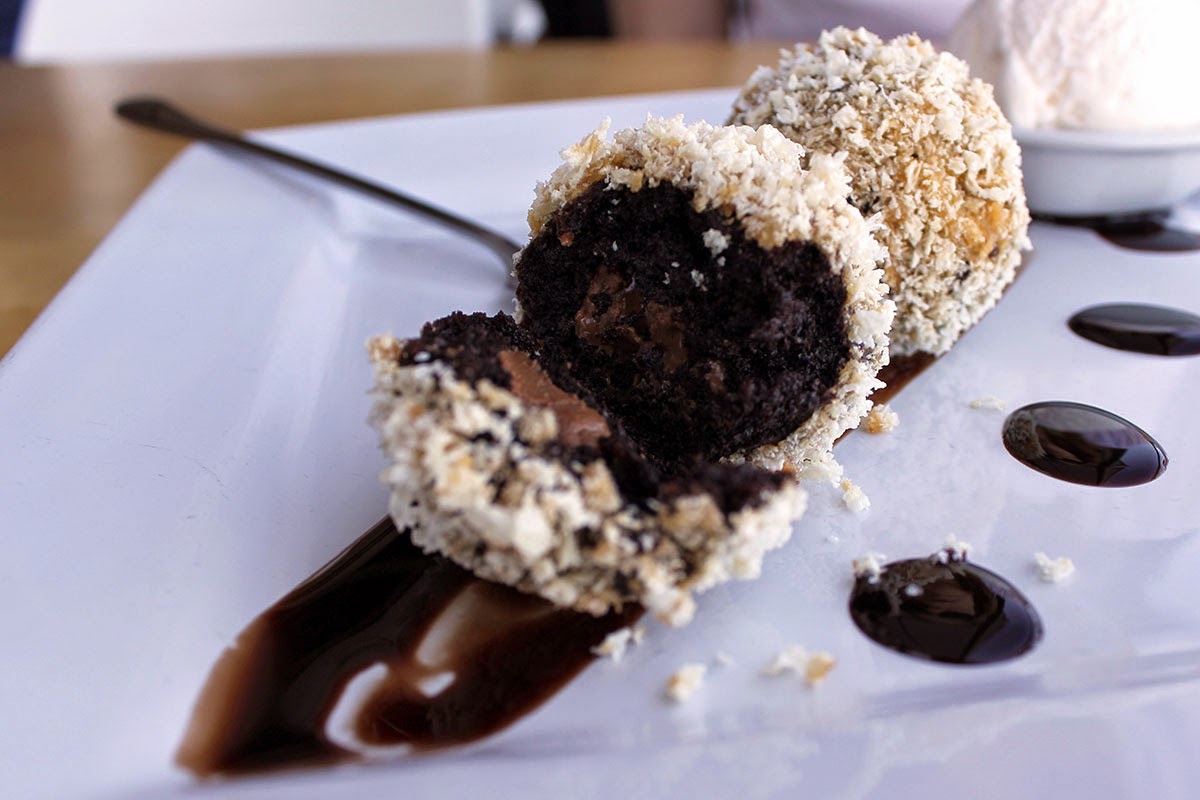
On the dessert front, there was a novel take on the classic chocolate brownie which has to be recommended: two spheres of brownie each surrounding a caramel centre and carefully coated in Panko crumbs! A fantastic idea and a winning combination. The brownies were served with vanilla ice cream, however, which I have recently decided needs to be banned from all restaurants nicer than a Spur (homemade ice cream with real vanilla excluded). Let’s get serious and have some salted caramel ice cream or pistachio and honeycomb, or butter pecan. Vanilla is so done.


Jack Salmon's is not a cheap and cheerful spot (they consider themselves ‘semi-fine dining’ and most of the main courses will set you back around R140), so you do go expecting a lot. I did have a couple of criticisms, but that won’t stop me from coming back for more at some point - even if only for sundowners and half price sushi.


Tuesday, April 29, 2014

Max's Lifestyle, Umlazi

It's another sunny Saturday afternoon on the East Coast. The sky is an uninterrupted blue ceiling and a gentle breeze is stirring through the palms. We're relaxing at a smart wooden outdoor table on a raised deck shaded by a large awning.  Around us, tables full of friends laugh, drink beer and consume large quantities of braaied meat off wooden platters. The crowd is mostly young and trendy, men dressed in Soviet jeans and Guess T-shirts, ladies in high heels and figure hugging dresses. There are families here too, with prams and babies in tow. All in all, a fairly unremarkable scene, other than that this double storied entertainment venue and restaurant is not in town, or the suburbs, but rather in Umlazi township, V section, 1328 Mbe Road.


We're out for lunch at Max's Lifestyle. The incomplete sounding name is reflective of the fact that the venue is not easily defined as a restaurant, a tavern or even a club - its all of those things, but it's more than that too. Max's started out in 2002 serving braaied meat from a single roomed shack next to a taxi rank, but under the savvy ownership of Max Mqadi it has expanded into a bustling bar, lounge, butchery and restaurant that is known as a place to see and be seen. It's frequented by government bigwigs, local celebrities and assorted black diamonds as well as locals, and is the venue of choice for those seeking a dose of authentic Kasi (township) culture.

The dining experience here has a uniquely township flavour - there are no waiters or menus, so we order a couple of beers from the bar while we watch the regulars to see how its done. The bar is outfitted with dark wood and granite tops, so don't expect to order quarts - you can get bottles or draughts of the usual SAB fare as well as high end whiskys and spirits - Dom Perignon, Henessy and Belvedere rub shoulders with Johnnie Walker Blue and 21 year old Glenfiddich. It's lunchtime, so we stick to Castle Lite and enjoy the music and the people watching. The bouncer is doubling as a DJ, and spinning a range of tracks from R&B slow jams, to Afro-soul and even Westlife on one occasion.


Turns out that its pretty easy to place an order - the first step is to take a short stroll over to the built in butchery at the back of the deck. There's a refrigerated glass display case and you get to pick your own meat and then sit back and relax while it's expertly grilled and returned to your table. The butchery focuses on cheap cuts - there are mounds of thinly sliced chuck steak; heaped piles of beef short rib; pork chops; chicken pieces and thick loops of boerewors. There are also whole beef livers and tripe if you're into internal organs. The ladies behind the counter will individually weigh and price your selections and pile them onto a wooden slab before liberally dusting them in a mystery powder from a large plastic container.

'Aha - Max's famous special spice mix?' I ask the lady behind the counter - 'what's the secret ingredient'? She looks confused. 'It's barbecue spice', she says. Oh well.


After paying (prices err on the ridiculously reasonable side - lunch set us back about R80 for two, exluding drinks), the meat board is handed back to the customer, who carries it to the braai area out back. Here a sweating staff member is tending to two heavily laden 40 gallon drum braais. There is a haze of smoke, and the smell of sizzling steaks mingles with the scents of charcoal, roasting chicken and the fat that's dripping slowly into the flames.


Service is relaxed rather than prompt, but when the meat arrives it is worth the wait. The chicken wings make perfect finger food starters, and have a lovely flame-grilled finish, while the boerewors is of surprisingly good quality - juicy, well spiced and bursting with flavour. The beef short-rib and the chuck steak taste great (maybe there is more to the barbecue spice than meets the eye), and while not tender, the enjoyment of gnawing meat off the bone should not be underrated. There are no utensils here, save a single steak knife, and no plates either so meat is enjoyed the way nature intended, out of your hands.

It's obvious that Max's is run by a man - there are no vegetables in sight, with all of the sides on offer being starchy in nature - steamed bread (ujeqe), dumplings (dombolo), and pap are headliners. Many of the tables near us forego sides altogether and simply devour their huge platters of meat washed down by endless rounds of beer.

We order pap, which comes in a polystyrene container and is thick, stiff and cool, contrasting nicely with the hot, fatty meat. An additional side is a disposable cup holding a generous portion of a thick red chili sauce that would not look out of place in an Indian restaurant. According to Max's legend, this sauce is the perfect cure for a hangover. The only other seasoning is two little piles of table salt served on the meat platter.


There are no desserts to speak of, although the butchery does include what is basically a small spaza shop selling chips, cool-drinks, and ice creams, so you can always finish your meal off with a Magnum if you feel so inclined.

Umlazi is only a few kilometers down the road from the more familiar face of Durban, but it would be easy to spend a lifetime in the city without visiting South Africa's second biggest township (after Soweto). Max's stated aim of creating a space frequented by all cultures and races is the perfect invitation to explore this world - and get a great meal into the bargain.


Saturday, April 26, 2014

Cafe Abyssinia

An enormous, shallow platter is gently lowered onto the table before us. Completely covering the dish, and extending slightly over its edge is what appears at first glance to be a thin, off-white flannel table cloth. Resting on its surface in three bowls are fragrant stews of lamb, lentils and split-pea.

Our host, Charity, picks the bowls up one by one and gently spills their contents out onto the cloth. The cloth of course is not actually cloth, but injera - the famous flat bread of Ethiopia.  The porous surface of the bread immediately begins to soak up the flavours of the stews and the air is filled with the aromas of berbere, an Ethiopian spice mix featuring chilli, coriander, fenugreek and more.


At Durban's Café Abyssinia, as in the horn of Africa, the bread is at once plate, food and utensil. There are no knives or forks needed here. You simply tear pieces of injera off the edges of your platter, scoop up a morsel of stew and pop the whole thing into your mouth.


The injera has a unique, slightly sour, lemony flavour - the result of a fermentation process similar to that used when making sourdough. Some consider it an acquired taste, but I happily acquired it on the first bite and kept on eating until the platter was clean. Traditionally prepared on a large clay plate over a fire, here it is made in what looks like an enormous electric frying pan, almost like a pancake. Because injera is not flipped, the underside remains smooth, while the top is spongy and perfect for soaking up juices.


Of course man can not live on injera alone, and the selection of wats, or Ethiopia's answer to the curry, are the perfec partner for the slightly sour flavour of the bread. We selected a yebeg alicha wat (lamb stewed with garlic, onions and tumeric), shiro (split peas) and misir (lentils) wot. Each dish was delicious, with just enough chilli to raise a mild sweat, but nothing that would detract from the depth of flavours imparted by the gently cooked meat, pulses and Charity's special berbere mix.

Vegetarians will rejoice in the fact that Ethiopians are strict observers of various fasting days when meat is avoided, and half of the menu options at Café Abysinnia are meat-free. For carnivores, there are beef, lamb, chicken and even seafood options, and the doro wot (chicken in lime, garlic, ginger and berbere) is apparently particularly good. On our visit, we also enjoyed a starter of beef meatballs, which came in a fantastic garlicky sauce that ended up being mopped up by extra injera when our main course arrived.


You will be surprised at how easy it is to put away a manhole-cover sized portion of injera, so be sure to order three or four wat's per couple. If there are more of you, just keep ordering - Charity will bring extra injera to the table in little rolls.

Café Abyssinia is unlicensed, so bring along a bottle of wine to enjoy with your meal (no corkage was charged). After dinner, be sure to order the coffee - Ethiopia is the birthplace of the bean, and coffee is served hot and black out of a clay pot, alongside lashings of sugar. I generally take my coffee with milk, but this brew managed to be strong without being bitter, and in an interesting twist, is served with a bowl of popcorn, apparently an Ethiopian tradition.


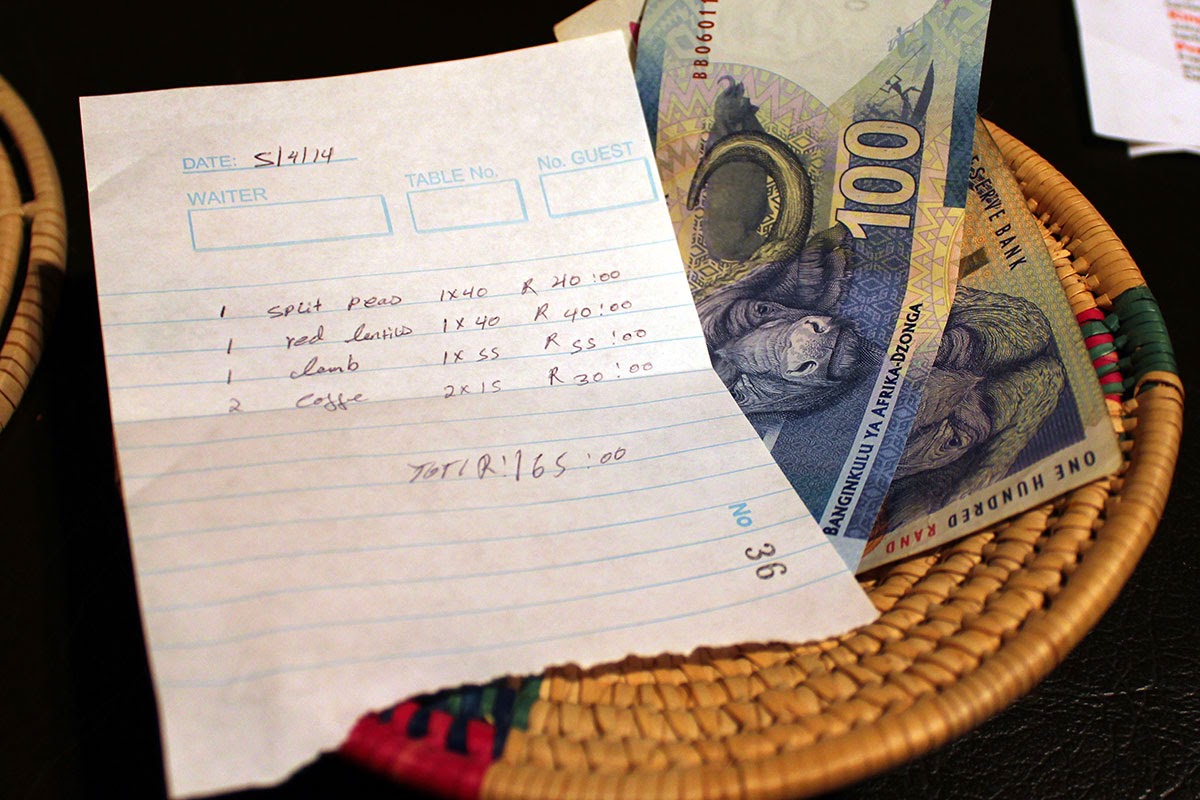
Prices are extremely reasonable. Wats vary from R40 to R60, coffee is R15 and injera is complimentary. Service is slow, but friendly as Charity works in the kitchen, front of house and as a waitress. It's not a big space, with only five or six tables in a room that spills out onto the pavement and the decor is minimal, but appropriately themed, with Lions of Judah and Ethiopian flags lending an out-of-town appeal to the place. Get there soon, before the whole of Durban finds out about it.


Tuesday, April 1, 2014

Cake and Satay House

Eating out is something I love to do for a variety of reasons, one of the least of which is simply to satiate my hunger. Yes, I'm a hungry hedonist, but the emphasis is strongly on the hedonism - I eat out for the pleasure of it. One of my favourite activities is exploring a country through its food - ideally in a street market or bazaar, but otherwise while discovering new flavours right here in one of our Durban restaurants.

The Cake and Satay House, specialising in Indonesian food is just such a place where one can go to experience something new. Often described as being in Umbilo - probably because of its proximity to Umbilo Road, it's actually situated in Glenwood, in Albert Dlomo Road (formerly Willowvale), not far from Parc Café and Glenwood Bakery. From the street, a small sign indicating 'Cake and Satay House: Indonesian Delicacies' is the only hint at what lies behind the door that leads up a short flight of stairs to the front room of Anita Leong's house. Here, her and her husband serve up a variety of Indonesian, Chinese and Thai inspired dishes to a small, but appreciative audience.


At the top of the stairs, a security door is opened before you can be beckoned inside. There are two eating areas: a small, enclosed outside room, ringed in fairy lights, and inside, a slightly larger room with a row of tables running down the centre and a display case featuring a handful of sweets and sauces for sale. There are only four or five tables in the restaurant, with a potential capacity of about 20 diners. On the night that we visited, however, we were the only customers. You have to book for dinner here, not only to ensure that you get a table, but also because there is a fair chance that the restaurant won't be open otherwise. 

Ambiance comes courtesy of a single CD of traditional Indonesian music, which reminded me vaguely of the Midi soundtrack on a 1980s video game. It's probably not the ideal restaurant for a first date, but it's a great place to come with a bunch of friends who are happy to create their own buzz. They aren't licensed, so its strictly BYOB, but they don't charge corkage, and they do stock a variety of cool-drinks if you prefer. Also, remember to bring cash - they don't accept credit cards.

Starters are limited to a selection of fried delicacies (wontons, spring rolls, crispy prawns) or soups (chicken or wonton). They also serve those colourful, tongue-sticking, deep fried prawn crackers - either individually, or by the plate. The wontons are hot, crispy and filled with minced pork; the spring rolls are enormous and bursting with crispy vegetables, pork and prawns. A bowl of bright red sambal oelek (basically raw chilli paste) and soy sauce is served alongside, with a small plastic spoon. It's Asian street food, simple, tasty and good for sharing.


The main course options are more extensive, with separate sections for Nasi Goreng (fried rice); Mi Goreng (fried noodles, much like Chinese chow mein); sweet and sour dishes; cashew chicken; black bean dishes, and the titular satays. There are also a handful of sea food dishes, including curried and chilli crabs, which are apparently excellent.

I went for the house speciality and ordered the chicken satay, served ten kebabs deep, with a fantastic, spicy peanut sauce. The pieces of meat are smaller than on a typical South African sosatie, and more tender, coated in a sticky sweet and salty sauce which has blackened on the edges where the flames have caught at it. The satay is served with a small bowl of plain steamed rice - good for when you accidentally eat too much sambal oelek.


We also ordered beef in a black bean sauce and sweet and sour pork. Both came with plenty of lightly fried peppers, onion and carrots. The sweet and sour pork was crunchy-edged, and came with a dark, pineapple-sweet sauce. The black bean dish was full of tender beef, mushrooms and vegetables, although the sauce lacked depth and could have used more black beans and coriander.


As far as I know, Cake and Satay House is the only restaurant in Durban specialising in Indonesian food. If you get a taste for it though, as I have, you can also get lucky at the Durban Night Market where you'll find Suki's Indonesian Food, offering a fantastic selection of satays, Nasi Goreng and Mi Goreng. Now I have to go try that Ethiopian place on Cowey Road...