Secret Eats, the 'Underground Dining Experience' is back in Durban, having taken a leave of absence for most of the last year. My first taste of Secret Eats was back in June 2014, when it burst onto the Durban dining scene with a bang, pairing the edgy, urban hangout of the Factory Café by night with the renowned cooking of Marcelle Roberts of Café 1999.
The concept of pairing an unexpected, out of the ordinary space with a talented chef is a winning one, and pairing it with a heavy emphasis on social media buzz ensured that Durbanites were lining up for elusive tickets to the next event.
The first event in Durban in many months was announced online with much fanfare, and I was happy to grab two tickets, to see if the kind of magic that had been conjured up in the past could be created again. Secret Eats events are a bit of a lucky-packet leap of faith, as you have to pay upfront without knowing where the event will be hosted, or who the chef will be. Parting with my R1190 (R595 a head) I crossed my fingers, and hoped that the outlay would be worth it.
On the morning of the event, I received an email revealing the secret location for the event - The Green Door in Glenwood, a flexible events / shared office space converted for the night into our venue (it's next door to the Coffee Tree café).
Normally at these events, there's a bit of a fuss made about knowing a secret password to gain access. Silly, but sort of fun. This evening fell more on the silly side, as we delivered our line, and then rather than being ushered into a hidden venue, we were instructed to stand awkwardly on the pavement, where a gentle drizzle was drifting down.
A welcome drink of white wine sangria (peach, strawberries, Ernst & Gouws Sav Blanc, refreshing) was served, and gradually the guests for the night accumulated, up to the final total of around 35 or 40. While we stood on the pavement, sipping sangria and making an effort to feel sophisticated, we nibbled on mouth-sized bites of curry served on a kind of tortilla chip - lamb, cauliflower and chicken versions were served on mirrored trays, all very tasty.
Moving indoors, two rather sparsely decorated long tables were squeezed into the limited space, and the usual seating dance ensued, as everyone tried to sit next to either the people they came with, or having come on their own (as we did) opposite somebody who looked like they would make good conversation. This is actually one of the highlights of these events, as the chance meetings are almost always interesting and a fun way to meet people you wouldn't normally.
A card on the table informed us that the theme for the evening was South African flavours, in an unfortunately timed nod to the rugby world cup (minutes earlier, New Zealand had booted us out of the semi-finals). The chef was chef Ros (no surname given) of Olive Twist, a 'Bespoke Catering Company' according to their website.
The 'Coastal Consommé' starter was a winning effort, served in a tall glass bowl, and looking for all the world like a rock pool on a summer afternoon, complete with plump prawns, slivers of fish, rice-balls and salty broth. Fun to look at and to eat. The paired wine was a rather decent Chardonnay.
Lacking from the evening, sadly, was any real introduction to the chef, discussion of the food we were about to eat, or information about the paired wines being poured. This kind of fanfare at previous Secret Eats was part of what gave one the impression of being privileged insiders, rather than regular restaurant patrons.
Too soon after the starters were cleared, mains began to arrive, in fits and starts, with one end of a table being served, while the other waited. Service was not a high point of the evening, and waiters were generally only good for shuttling food from kitchen to table, and had none of the repartee and energy of the more student-y waiters from previous efforts.
The main course was described as 'a delicious black salt crackling of slow cooked pork, served with a true homage to our wonderful rainbow nation'. The true homage to our wonderful rainbow nation turned out to be steamed tenderstem broccoli, potato bake (the chef would have probably said 'potato gratin' and a lonely asparagus spear). Crackling was sadly noticeable by its absence (there was none on my or my wife's plates) and the dish was only just warm. Sure, the pork belly was soft and tender, but spice was lacking, and the whole dish brought to mind upper middle class weddings, which presumably is where it was first delivered. Buyer's remorse was starting to set in at this point.
Happily, dessert was more inspired, being a Durban inspired curried pineapple, served on a kind of cocoa/biscuit ground, and served with chocolate truffles and a dollop of ice cream. The tall glass bowls were back out, and we had another round of scooping food out from the bottom, which was quite enjoyable.
And that, sadly was that - having begun starters at 8, dishes were cleared by 9.30. No coffee was on offer, nor were any drinks available other than the paired Shiraz and Merlot. Not being a big red wine drinker, I returned to the welcoming sangria. An earlier promised charity raffle either failed to materialise, or took place after we hailed our Uber home at around 10.30.
My unsolicited advice for the continued success of this enterprise? First of all, pick venues with a little more of a wow factor. The Green Door seems like a lovely space, but doesn't exactly take your breath away. Try to work with chefs that enjoy greater name recognition - good food is not all we are looking for, we want a chance to see what our favourite chefs can do outside of their usual kitchen and regular menu. Make sure you employ waiters with a bit of personality. Have drinks other than the paired wines available. Generate a little anticipation for each course, and impress us with detailed descriptions of what we're about to eat. Put on some music, preferably live. Ramp up the number of courses. Keep your plates warm. Make this a secret too good not to share.
Monday, October 26, 2015
Sunday, December 21, 2014
El Hombre, Florida Road
El Hombre in Florida Road (next to Spiga). Dropped in for a late lunch today and tried out the burrito and the taco. Ordering is fun, you pick your category (burrito, taco, nachos, etc), then main filling (beef, pork, chicken) and finally select from a variety of toppings, kind of like getting a schwarma.
We tried the burrito with slow roasted brisket and the taco with pulled pork. Plenty of delicious salsa, guacamole and refried beans in there as well. The food was delicious, healthy and full of zingy lime and jalapeno flavours. Service was friendly, and the place was very quiet when we visited.
Washed it all down with an ice cold Corona, and finished off with the chili chocolate churros - don't skip them, they are moreish! Well worth supporting in my opinion. Tacos/Burritos are about R50 each, churros only R20.
Zak and Tonics Asian Pop-Up
Zak and Tonic are as ubiquitous in Durban outdoor dining circles as bunny chows or braaivleis. You’ve eaten their silky and elegant crepes at The Morning Trade at 8 Morrison. You’ve devoured their Super Steak Rolls at the I Heart Market, or their fragrant pulled pork buns at the Market in the Square. You’ve seen them at the Wonder Market, you’ve spotted them on rooftop pop ups, and chances are you’ve even been hosted by them at one of Durban’s always popular Secret Eats evenings.
This was a unique opportunity though to see what they could really do when given free reign over a menu and a kitchen, for two nights only with forty people dropping in for an Asian inspired feast.
The venue was The Foundry at 43 Station Drive – a renovated former clothing factory, and now a creative space that hosts workshops, studios and collaborative offices. For the night though, it had been transformed into a hidden Asian underworld. Two long trestle tables covered in cryptic Chinese newspaper and lined with chairs and benches were dotted with candles, while fairy lights illuminated the room and supported strings of airy origami cranes.
Welcome drinks were strong and pink, and segued nicely into a cash bar, which was doing a roaring trade in wine, champagne and craft beers. Zak was everywhere, plying the guests with generous tray-fulls of pea and green tea croquettes with kewpie mayo, while waiters handed out painstakingly handmade sago chips with a peanuty Thai dip. The volume levels climbed as the room filled up, and soon we were jostling for places at the tables as a beautiful starter of Tonic’s take on kim chi and prawns was served on folded banana leaves.
For me, though, the magic was really revealed with the dim sum courses. Bamboo baskets of steamed buns (char siu bao) were unveiled, their plump soft roundness just asking to be broken open and enjoyed. Crispy chicken wontons were held aloft on chopstick points, and dunked in sweet dipping sauce before being eaten, and platefuls of dumplings circled the table, at first handed over grudgingly, and then more freely, as the extent of the bounty was revealed, with plate after plate distributed among the diners.
To be honest, the next course probably wasn’t strictly necessary – as we were already as full as the well-stuffed dim sum we had just demolished. The description of the beef short ribs had us ready for more, though, with cooking times of six to eight hours bandied about, and obscene details revealed about the meat falling off the bones. Let’s just say that you know a rib is tender when you can eat it with your chopsticks.
Finally, we were presented with coconut flavoured ‘sunscreen’ ice cream topped with some kind of ginger snap, and an old enamel bowl filled with white rabbit candies – what is it with those sweets that makes the rice paper wrapping taste so good as it melts on your tongue?
Tired, sated, and buzzing with beer and good conversation, we trickled out to the waiting cabs, Uber rides and Good Fellas. There were hardly enough hours left for a good night’s sleep before it would be time for my Saturday morning park run ritual. At least I knew I would be able to pop by Moses Mabhida for a Zak and Tonic steak roll if I needed it.
Want to know what Zak and Tonic are up to next? Join their mailing list at hello@zakandtonic.co.za, find them on Facebook, or follow them on Twitter @ZakandTonic.
Monday, September 22, 2014
Secret Eats: Open Plan Studio
At the Design Factory's Open Plan Studio in Morningside, four floors above the
empty streets, long wooden tables stretch across a sparsely decorated
industrial space. The tables are strewn with artfully arranged stacks of old
books, ceramics and antique appliances. At each place setting, long rows of
assorted cutlery reflect the candlelight: two knives, a fish knife, three forks
and a spoon. People sit on mismatched chairs - ten to a side and the noise of
animated conversation almost drowns out the background music as bottles of wine
are passed from one side of the table to the other.
It’s Friday night, and it’s time for another once off event
hosted in Durban by Secret Eats, the underground dining experience with limited
seats and largely word-of-mouth advertising. The crowd have gathered here for a
unique dining experience, this one catered by Tarnah Blane, a graduate of
Christina Martin and owner of Private Chef Ballito.
Why go to the effort of applying for invitations to attend
pop-up restaurant in out of the way parts of town, or trying to remember the
tongue-in-cheek passwords at the door that are part of the Secret Eats
experience? Part of it is about the food, which is out of the ordinary, different
every time, and follows a set menu format that forces people out of their
comfort zones. Mostly though, I think it’s about the people who attend - the
spontaneous friendships that emerge across the shared tables, and the chance to
discover parts of the city where most of us wouldn’t ordinarily go.
The evening starts well with welcome cocktails and live
music from the talented Phil Moffett, who does strange things to a guitar that
sound pretty amazing (apparently it’s called slap harmonics). The cocktails are
served in retro glass ‘Cooee’ bottles, and involve what feels like large
quantities of gin, rosewater and those hipster-y paper straws. The evening’s
theme is #SouthAmericanFlavours (Secret Eats is big on social media) so we
snack on empanadas dipped in fragrant chimichurri sauce and choripanes
(effectively pork sliders, named for their two main ingredients, grilled
chorizo sausage and pan, or bread) as
we mingle and meet some of the other guests.

We move through to the tables which have unreserved seating,
and form naturally into large groups of new found friends. I might be imagining
it, but the one table seems to hold a mostly 30s crowd, while the other table
is favoured by slightly older diners. We’re sitting at the kids table!
For starters we are served ceviche, the unofficial national
dish of Peru - raw fish marinated in citrus juices, and effectively ‘cooked’ by
the acid, leaving it tender and slightly chewy with a delicate flavour that
really reveals the fish – a perfect food for Durban! This one is adventurously
combined with toasted coconut flakes and fried banana fritters. Personally,
bananas are the one food that I refuse to eat, so I simply push the fritter to
one side. The fresh yellowtail, purchased the same morning from the docks is
meltingly tender and simply dressed. The crunchy flakes of coconut add a fun
textural component that really pulls the dish together.
Next, it’s a second starter sized portion of panqueques con pollo a la crema (chicken
wrapped in a pancake with butter beans, and served with avocado salsa). Pretty
tasty, although it could have been served warmer – a challenge for the chefs at
all of these functions is cooking for a crowd out of what is generally a
makeshift kitchen. Still, the plates are heading back to the kitchen wiped
clean, and we are clamouring for more.
The main course is shredded venison (blesbok) served atop a
pile of quinoa risotto and chargrilled sweetcorn and decorated with micro
herbs. Quinoa’s gluten-free status and high mineral and protein content have
made it a trendy superfood, but as well as being good for you it’s also really
delicious, and (we discover) goes fantastically with blesbok. Cell phones and
cameras are hovering over dishes before they are devoured, as each course is
sent out via Twitter and Instagram to those unfortunate enough to have missed
out on tickets.
Two of the guests are celebrating their birthdays, and there
is an impromptu performance of unaccompanied singing from Ian – a Drakensberg
Boy’s alumni who is sitting opposite me. Everybody pauses to enjoy the moment,
this is the kind of thing that makes these evenings what they are – a little
out of the ordinary.
Finally we reach the dessert course, which is bread and
butter pudding of croissant (known as medialuna
in Argentina for their half-moon shape) with dulce de leche and Chantilly
cream. It’s served in a tin mug, and it’s decadently soft and sweet – a perfect
end to the meal.

Open Plan Studio has a photo booth set up, so we
gather for photographs with some of the table, as well as Zak and Tam (of Zak
and Tonic, who run these evenings). Arms are thrown around shoulders as we
huddle up for a pose – just another group of old friends that met a couple of
hours ago.

Habesha Café
Visiting Habesha Café in Glenwood’s bustling Helen Joseph
Road feels like being welcomed into an inviting, spice-scented Ethiopian home.
The venue is in fact a converted house, with old Berea yellowwood floors; high
ceilings, and generous bay windows. Warm Durban sunshine streams past hessian
shades, colourful cotton curtains and across casually scattered low seats. Chairs
are arranged around tables, or informally into circles, surrounding the
brightly coloured woven stands that carry the communal plates which Ethiopians
traditionally eat from.
The term ‘Habesha’ is a word used among Ethiopians and
Eritreans to refer to themselves, in a unifying fashion rather than delineating
groups along tribal or regional lines (check out the hashtag #HabeshaProblems on
Twitter for a humorous take on traditionally strict Ethiopian parents with high
expectations). No Habesha problems here, though – on arrival, you will be
ushered inside by the gracious, soft-spoken hosts Biniam and Fev, who treat you
more like returning friends than patrons.
If you’ve eaten at an Ethiopian restaurant before, you will
have a good idea of what to expect from the menu – a variety of chicken, beef
or lamb ‘wots’ (spicy stews) as well as a good selection of vegetarian dishes,
featuring split peas, lentils and chickpeas. The traditional spice mix
‘berbere’ appears in many of the dishes, and carries the warm familiar flavours
of chili peppers, garlic and ginger, as well as others that may be harder to
place: korarima (the dried seeds of a
ginger which grows wild in the horn of Africa), nigella and fenugreek.
Select a variety of dishes, place your order, and soon it
arrives, each wot presented in a separate bowl, and resting on a white
tablecloth of injera, the distinctive flat bread which serves as both plate and
utensil. In case you run out of bread with which to eat your meal, a bowl full
of extra injera is served alongside, in neat little rolls. Injera is made from
a fermented dough and has a lemony, slightly sour taste – Habesha’s version is
quite mild, however, with just a hint of acid.
On our visit, we demolished a combination of tibs firfir (cubed mutton curry tossed
through with injera), shiro wot
(split peas) and misir wot (lentils).
The lentils were served in a wooden bowl that seemed to add to the flavour. Eating
with our hands, the injera acted as an artist’s palette, each dish a flavourful
colour, to be mixed, swirled and recomposed into a personal work of art.
Delicious, edible art.
Forget the tired dessert options of ice-cream, crème brûlée
or chocolate mousse. Here in little Ethiopia, meals are concluded with a
generous bowl of sweet and sticky pitted dates. Fev brings us black coffee,
served in a long-necked round-bottomed clay jebena
and poured into small pottery cups. The coffee is served with freshly popped
popcorn, which goes surprisingly well with the dates. We also tried the mint
tea, flavoured with fresh mint leaves and brown sugar.
Habesha Café is not licensed, so bring your own bottle, or
try their fresh juices like the mango and avocado. Dishes are very reasonably
priced, and our meal for two including three wots, drinks, tea, coffee and
dates came to just over R200.
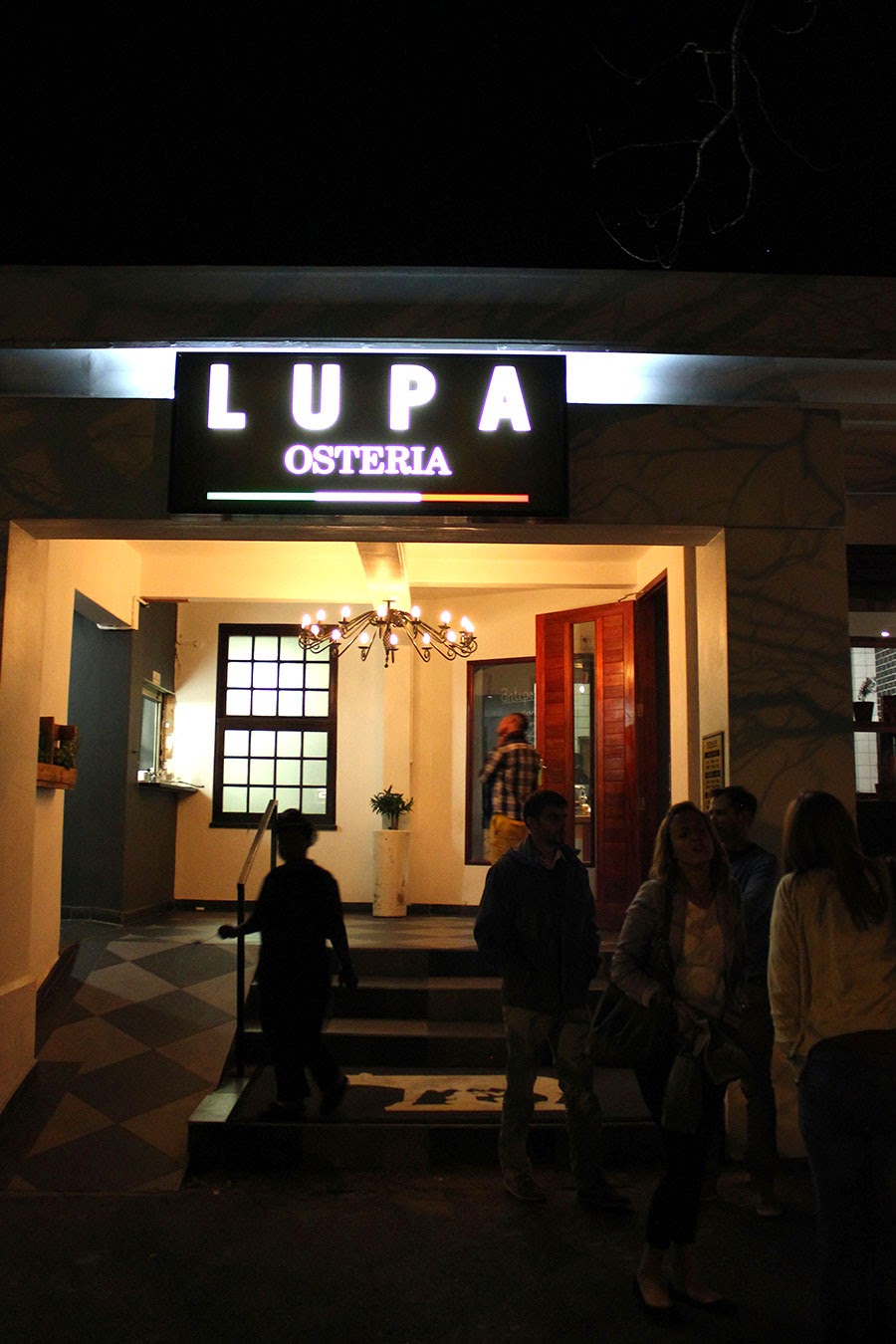
Lupa Osteria: Westville
For the past few months, Westville has been buzzing in
anticipation of the opening of Lupa Westville. Situated in a prime position on
Jan Hofmeyer Road (Westville’s restaurant strip) the chip off the Hillcrest
block has quickly taken shape on the site that until recently held old favourite
La Storia. Looks like there’s a new Italian in town.
In place of La Storia’s laid back décor of mismatched chairs
and tables, Lupa has mimicked the more upmarket feel of its Hillcrest venue, with
large black and white tiles; pillars clad in rough timber; raw brick and slate
grey walls. Many of the best aspects of Lupa Hillcrest have been replicated
here – including the cocktail menu - which was where we started - enjoying a
Romulus and a Remus, named for the twins of Rome’s founding myth (Lupa was the
wolf that raised them after they were thrown into the river Tiber by their evil
uncle). Sadly the glasses of breadsticks which we enjoyed on our
last visit to Hillcrest were not on offer here, hopefully they will still make
an appearance.
The clientele are probably a little older, a little less hip
than the Hillcrest crowd, but they certainly seem to appreciate the food, the
restaurant has been open for a month already, and this was the first time that
we had managed to secure a table. By 7 o’clock on a Saturday night the place
was already bustling – it seems that in Westville as in most of Durban, people
like to be in bed by 9.
Presumably due to the newness of the kitchen, there were no
specials on offer for the night, so we stuck to the menu, which in its defence
is full of good choices, from the traditional pizza and pasta, to some
interesting sounding veal, lamb, fillet and line fish dishes. I opted for the
fillet escalope, where the meat is thinned out slightly with a tenderising
mallet of sorts, making for a super moist and perfectly medium rare cut that
fell apart as I attacked it. The fillet was topped with perfectly ripe avocado
and oven roasted tomato, and served on a mushroom risotto (slightly underdone,
as seems to always be the case at restaurants). All in all, a very nicely put
together meal.
The gnocchi salsicce with fennel sausage, bacon, cream and Chianti
was also good – a hearty dish with a rich, red sauce, although slightly over
salted, which seemed to be true for the pastas at the table too. I had a taste
of a friend’s chicken marsala, which was excellent.
Dessert offerings include tiramisu, crème brûlée, and dark
chocolate tart, but we settled for scoops of the creamy and chocolate-filled
home-made ice-cream, strong espressos and an affogato. I saw other tables enjoying
the ice-cream in a sugar cone, which looks like a fun way to end the evening.
Westville is certainly better off for the arrival of Lupa,
which together with the Olive and Oil Café adds some much needed variety to the
local dining scene. While the Hillcrest Lupa is probably a little more flash –
Westville is a lot closer if you’re visiting from Durban. For inhabitants of
Westville, it’s our new local.
Marco Paulo
Back in January, I reviewed the excellent Frank’s Speakeasy
in Mount Edgecombe, and had plenty of good things to say about their wide range
of beers, super-cool waiters, and epic burgers. Of course Frank’s is only half
of the story, and is separated from the more upmarket Marco Paulo bistro by only
a colourful stained glass window.
Marco Paulo itself actually has quite a lot of glass, with a
semi-circular floor to ceiling glass wall forming the front of the venue,
providing views into the bustling depths of the single space restaurant that
holds 20 or so tables. Sadly the view from inside the restaurant looking out is
only of the parking lot, which tends to be a bit annoying when SUV headlights
are flicked on and glare inside.
On the night that we visited, it was unusually cold for
Durban, and the first table that we were seated at felt cold and soulless,
being placed directly against the glass wall, with the bright lights of the
parking lot spilling across the table, and the cold air from the open doors whistling
past us. Happily, after making our unhappiness with the seating arrangement
known, the manager very smoothly relocated us to a table deeper inside the
room, which suited us much better. The more exterior tables are probably a
great place to sit at during the day, but definitely not where you want to be
for a romantic dinner.
Speaking of romance, many of the reviews of Marco Paulo
mention that it is a very loud space, which is true – not necessarily a bad
thing, but the atmosphere is more bustling than intimate. In my review of
Franks I mentioned the great 90’s soundtrack of Counting Crows and Third Eye
Blind – unfortunately on this visit, the same 12 songs (Counting Crows featured
prominently again) were on repeat, meaning that we heard each song twice by the
end of our meal. When one can fit almost 500 songs onto an ipod shuffle, this
is really inexcusable, but it has happened at two of the restaurants that I
have eaten at recently.
Technically, a ‘bistro’ like Marco Paulo is a small,
modestly priced restaurant that serves simple, homestyle meals. In recent
years, however, (or is it perhaps just in South Africa?) the term seems to have
taken on the opposite meaning, evoking an upmarket, fine dining atmosphere.
Perhaps 9th Avenue Bistro is to blame here. Anyway, Marco Paulo is on
the upper end of Durban restaurants, with main meals generally between R120 and
R180.
Marco Paulo styles itself as a ‘world food’ bistro, which is
kind of misleading, as the thrust is very much Italian, with pizza, pasta and
risotto sections on the menu. Throwing in a Thai red curry afterthought doesn’t
really make you world food. Actually, an international vibe would be nice, as
the menu choices, while tasty sounding, are rather traditional (fillet with red
wine reduction or peppercorn sauce, spaghetti bolognaise, Hawaiian pizza and so
on).
For starters I opted for the snails – there were nine of
them which was enticing, and they weren’t served in one of those weird little
artists palette plates, which was also nice – those always make me feel like
I’m in a pub. The snails came three ways; in a champagne butter, a more
traditional gorgonzola and a fairly unusual tomato and red pepper sauce. All of
them were good, although the gorgonzola was probably my favourite; I guess sometimes
the classic options are just the best.
Our other starter was the camembert spring rolls with a
chilli, tomato and ginger relish. The spring rolls were delightfully bite-sized,
a little stack of seven or so, and made for great finger food. The cheese was
good and strong, although the relish was a little uninspired, without much bite
provided by either the chilli or the ginger.
I had read a review that particularly praised the peri-peri
chicken, so despite not normally ordering chicken out, I decided to give it a
try, and was glad that I did. The bird was deboned, which makes eating so much
easier, and the sauce was wonderfully fragrant and spicy. It was served atop a
pile of shoestring fries, which soaked up the extra sauce in a very satisfying
half crunchy, half juicy kind of way. Apparently not everyone likes it served in
this fashion – the waiter offered to serve the chips on the side – but I
definitely recommend it as is.
Seeing as there is a whole risotto section on the menu here,
we assumed it would be safe to order a beef fillet with risotto side (underdone
risotto is my pet peeve). The beef fillet turned out to be excellent, one of
the tastiest, tender-est steaks I’ve enjoyed in Durban. The risotto, sadly, was
underdone – not terribly, but definitely more crunchy than creamy, so that was
disappointing. The red wine reduction was alright, although thin – a little
more reducing could have been done while the risotto finished cooking.
Strangely, a few large chunks of unadvertised butternut and some green beans
were hidden underneath the risotto, almost as if we were children that had to
be conned into eating our veg.
Desert – expect to see crème brûlée (we were offered
espresso flavoured) as well as chocolate fondant and some old school classics
including an apple crumble. After enjoying the fondant when visiting Franks, I
stuck with the tried and trusted and found it just as good the second time
around.
Verdict? Vibey atmosphere, good service, generally good food
(and an interesting wine list). If I had to summarise my issue with Marco
Paulo, it’s simply that the food is not as adventurous as I would have
expected. That, and the underdone risotto.
Subscribe to:
Posts (Atom)